
'The RBI's MPC will maintain the current policy rates (6.50%) at the policy meeting, given ongoing inflationary pressures.'

Reserve Bank of India (RBI) Governor Sanjay Malhotra said the repo rate cut in the February meeting of the monetary policy committee (MPC) was due to inflation aligning with the target and recognising the fact that monetary policy is forward-looking.

The rupee tumbled 3 per cent against the US dollar in 2024 as concerns over slower economic growth and a stronger greenback in global markets weighed, but it was among the least volatile currencies in the world and the headwinds may be less intense in the coming year.
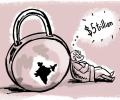
India decisively withstood global headwinds in 2023 and is likely to remain as the world's fastest-growing major economy on the back of growing demand, moderate inflation, stable interest rate regime and robust foreign exchange reserves. Despite widespread pessimism witnessed among the developed nations and the worsening geopolitical situation, India recorded a gross domestic product (GDP) expansion of 6.1 per cent in the March quarter. The growth moved up to 7.8 per cent in the June quarter and was 7.6 per cent in the September quarter. For the first six months of this fiscal, the growth was 7.7 per cent.

The Reserve Bank of India's (RBI's) state of the economy report observed that any durable alignment of headline retail inflation with the target of 4 per cent could recommence in the second half of FY25 and sustain until numbers closer to the target are seen during the course of FY26, dashing hopes of any reduction in the policy repo rate in the current financial year. The report, authored by RBI staffers, including Deputy Governor in charge of monetary policy Michael Patra, said though headline numbers may fall in July and August due to base effect, it is likely to reverse in September.

A quick bounce back of the Chinese stocks looks improbable now.

'We need to do more to accelerate growth.'

Gold prices advanced Rs 700 to reach a new lifetime high of Rs 91,950 per 10 grams in the national capital on Wednesday on the back of continued buying by jewellers ahead of wedding season, according to the All India Sarafa Association. Besides, increased tensions in the Middle East and concerns about the US economic slowdown have kept the demand for safe-haven assets intact.

The Consumer Price Index-based inflation rose to 5.11% in January

Undeterred by global credit freeze, India maintains a bullish outlook on attracting foreign direct investment which may be governed by easier rules, a top government official said.

The encouraging news, however, is that India features among the top four countries out of 44 nations that projected a positive hiring trend.

The IMF said global growth is projected to reach 3.9 per cent in 2018 and 2019, in line with the forecast of the April 2018 WEO, but the expansion is becoming less even, and risks to the outlook are mounting.

'In the past six months, capital markets have seen a dip, and realty is struggling. The stock-market investor will be cautious of putting that investment in real estate when there may be a slowdown coming.'

Like Slumdog Millionaire, RRR will remain a one-time phenomenon until another big, larger-than-life, Indian film connects with the critics in the West, predicts Aseem Chhabra.

Citing various macroeconomic parameters that are doing pretty well, India's G20 Sherpa and former CEO of Niti Aayog Amitabh Kant projected that the country is all set to overtake Japan as 4th largest economy in the world by 2025. The size of India's GDP is currently ranked 5th, after the US, China, Germany, and Japan. It overtook the UK in 2022.

'If gold's recent surge has increased its allocation beyond 15 per cent in your portfolio, now may be a good time to rebalance.'

India has secured the second position, contributing 36 per cent of the total brand value, a significant achievement fuelled by a 14 per cent increase in brand value, according to Brand Finance 2025 ranking. India follows the US, which maintains its dominant position in IT services brand value, holding 40 per cent of the total brand value.

The performance of banking and information technology (IT) stocks has had a significant impact on the composition of diversified mutual fund (MF) portfolios. Over the past two months, these sectors have become increasingly dominant, now constituting nearly 30 per cent of the total allocation in many diversified MF portfolios.

Despite volume growth in the export segment and strong demand in the domestic market, pricing uptick is eluding Indian agrochemical companies.

The US Federal Reserve's interest rate decision is the biggest event that would drive sentiments in the domestic stock market this week, besides a host of macroeconomic data from the global front and trading activity of foreign investors, analysts said. The Indian equity market had an exceptional last week, with both the Nifty and Sensex hitting their all-time high levels on Thursday.
The Indian IT services industry is expected to clock revenue growth in the mid-single digit for the financial year 2024-2025 (FY25), according to a report by Icra for the year.

Risks emerging from the US have left automotive investors worried. US President Donald Trump has announced 25 per cent tariffs on automotive imports, while global electric carmaker Tesla has taken its first steps towards entering India. While these developments are sentimentally negative for related stocks, it may be too early to conclude the eventual impact, analysts said.

The US Fed interest rate decision, domestic inflation data and global trends would be key driving factors in dictating movement in the market this week, as the Lok Sabha elections outcome and the RBI policy decision are behind us, analysts said. The past week was a roller-coaster ride for investors as markets swung sharply in both directions before closing with strong gains.

The size of Reserve Bank's balance sheet increased by 11.08 per cent to Rs 70.47 lakh crore as on March 2024, leading to the highest-ever dividend payout to the government, according to the central bank's annual report. In actual terms, the increase was Rs 7,02,946.97 crore over Rs 63.45 lakh crore as on March 2023.

'Challenge is basically near-term growth as the outlook has turned a bit adverse.'
Revising its economic outlook, International Monetary Fund (IMF) today marginally brought down India's growth rate projections to 5.6 per cent for this fiscal and 6.3 per cent for the next financial year.
IMF has sharply cut its forecast for world growth this year.

The world economy is going through a tough phase.

'BSE has facilitated nearly Rs 35 trillion in capital raising across multiple segments.'

The IMF on Tuesday projected a growth rate of 6.1 per cent for India in 2023, which is a 0.2 percentage point upward revision compared with the April projection. This is reflective of the "momentum" from stronger-than-expected growth in the fourth quarter of 2022 as a result of stronger domestic investment, the International Monetary Fund (IMF) said. "Growth in India is projected at 6.1 per cent in 2023, a 0.2 percentage point upward revision compared with the April projection," it said in its latest update of the World Economic Outlook.

After cement, billionaire Gautam Adani's group and Kumar Mangalam Birla's Aditya Birla Group are set for a face-off in the wires and cable business with both conglomerates announcing forays into the high double-digit growth sector.

The laggards in the Sensex kitty were Vedanta, Tata Steel, M&M, HCL Tech, Bharti Airtel, Maruti Suzuki, L&T, Asian Paint and HDFC

The central bank maintained its bias towards a rate hike.
Global rating agency Moody's Investors Service on Thursday said the Centre's fiscal deficit, which in the first quarter of 2006-07 crossed 50 per cent of what was projected for the whole year, is a matter of concern.

Even as the high inflation figure for October has ruled out any possibility of a rate cut by the Reserve Bank of India's (RBI's) monetary policy committee (MPC) in December, a rate cut in February also looks uncertain due to global uncertainties. Economists told Business Standard that unless domestic growth slows markedly, the outlook on rate cut remains unclear. India's headline inflation touched a 14-month high of 6.2 per cent in October, breaching the MPC's upper tolerance band of 6 per cent.

The Adani group is in advanced talks with top sovereign funds based in West Asia to raise up to $2.6 billion for its airport expansion and green hydrogen projects. The group, which expects to close the ongoing financial year ending March with Rs 80,000 crore of Ebitda (earnings before interest, tax, depreciation, and amortisation), has held a series of road shows in London, Dubai, and Singapore with potential investors, briefing them about their future growth plans. The group's flagship, Adani Enterprises, may dilute part of its stake in the airport-holding firm and/or the green hydrogen business to these funds, which are keen to invest in the Indian infrastructure sector, said a source close to the development.

Figure revised to three per cent from 2.5 per cent projected last quarter; telecom services market continues to be the largest in IT spending.

Amid rising geopolitical risks, a vast majority of Indian CEOs have indicated in a survey that they are reducing or planning to reduce operating costs, even as they are more upbeat than their global peers on their country's economic prospects. However, most of the companies do not plan to cut their headcount or salaries, found the annual Global CEO Survey released by consultancy giant PwC here on the first day of the World Economic Forum meeting on Monday. The survey also found that about four in ten CEOs (40 per cent of global and 41 per cent of India respondents) do not expect their companies to be economically viable in 10 years if they continue on their current path.
In its report, 'Global Economic Outlook: December 2011', the agency said the Indian economy is likely to regain the 8 per cent economic growth trajectory only in 2013-14.

Fitch Ratings on Thursday retained India's growth forecast for the current fiscal at 6.3 per cent citing economic resilience despite tighter monetary policy and exports weakness, but upped year-end inflation projection on El Nino threat. The Indian economy grew 7.8 per cent in the April-June quarter of current fiscal on strong services sector activity and robust demand. "The Indian economy continues to show resilience despite tighter monetary policy and weakness in exports, with growth outpacing other countries in the region," Fitch said, while projecting 6.3 per cent growth for current fiscal (April-March), and 6.5 per cent for next fiscal.
